

From Tactical to Strategic: 2025 Japan Dividend Rebalance
Published October 31, 2025

Research Analyst
Key Takeaways
- Japanese equities surged in October 2025 as pro-growth policy maker Sanae Takaichi rose to power, boosting expectations for fiscal stimulus and renewed market reforms.
- Despite rising trade tariffs, Japan’s exporters benefited from a weaker yen, helping the WisdomTree Japan Hedged Equity Index return nearly 28% year over year and outperform its benchmarks.
- Post-rebalance, WisdomTree’s Japan Dividend Indexes improved fundamentals, positioning them for stronger performance amid evolving global risks.
Many investors have long viewed Japanese equities as a tactical allocation—a way to express short- or medium-term views on currencies, interest rates and valuations. Yet, currency-hedged performance from the beginning of the Abenomics era challenges that view.
In 2012, then-Prime Minister Shinzo Abe introduced Abenomics, a series of reforms aimed at stimulating economic growth through monetary easing and fiscal stimulus. Whether Abenomics was a success is still debated, but, more than a decade later, the evidence suggests one clear outcome: with a currency-hedged approach, Japan has proven to be more than a tactical trade. The WisdomTree Japan Hedged Equity Fund (DXJ) outpaced the SPDR S&P 500 ETF Trust (SPY) since late 2012 by 37 basis points (bps) annually while the unhedged iShares MSCI Japan ETF (EWJ) trailed SPY by almost 680 bps.
Figure 1: DXJ Performance vs. Competitors sinceAbenomics
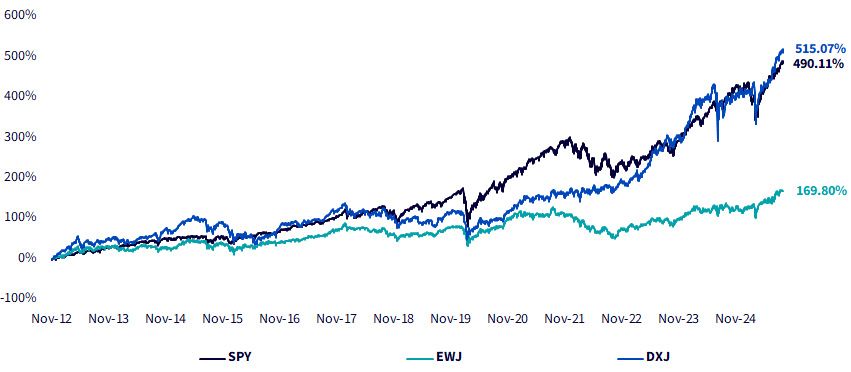
Source: WisdomTree. Data, 11/30/12–9/30/25. The performance data quoted represents past performance and is not indicative of future results. Investment return and principal value of an investment will fluctuate so that an investor's shares, when redeemed, may be worth more or less than their original cost. Current performance may be lower or higher than the performance data quoted. For the most recent month-end and standardized performances, click the respective ticker: DXJ, SPY, EWJ.
Japan's stock market began to surge in early October as Sanae Takaichi, a pro-growth policy maker known for her support of expanded government spending (much like her late mentor, Shinzo Abe), assumed leadership of Japan's ruling Liberal Democratic Party and markets priced in expectations of her becoming prime minister. The Nikkei 225 climbed to all-time highs, reflecting optimism about renewed fiscal stimulus and corporate reforms.
WisdomTree's Japan Dividend Indexes, which recently underwent their annual rebalances, offer a framework for navigating volatility as investors weigh global tensions and Japan's evolving economic outlook.
Figure 2: Nikkei 225 Index Price Levels
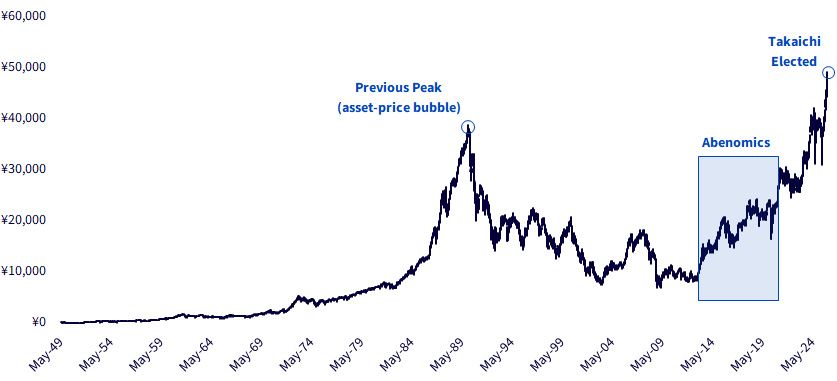
Sources: WisdomTree, FRED. Data, 5/16/1949–10/21/2025. Past performance is not indicative of future results. You cannot invest directly in an index.
Tariffs have dominated recent discussions around foreign policy and trade. Japan, a major export economy, is especially exposed. A 15% tariff was established as part of a deal involving $550 billion in Japanese investments in the U.S.—lower than the 27.5% initially threatened by President Trump but significantly higher than the rate Japan enjoyed prior to his second term.
While exporters navigate tariff headwinds, a weaker yen has offered some relief, partially offsetting the pressure. Following its rally earlier this year, the current JPY/USD spot rate at the time of writing sits about 7% below its April peak.
Amid these crosscurrents, the WisdomTree Japan Hedged Equity Index—which is tilted toward dividend-paying exporters and seeks to replicate local equity returns—returned 27.94% over the one-year period ended September 30, outperforming its benchmark, the MSCI Japan index, in both Japanese yen and U.S. dollar terms. The Index is tracked by the WisdomTree Japan Hedged Equity Fund (DXJ).
Figure 3: WisdomTree Japan Hedged Equity Index Total Returns
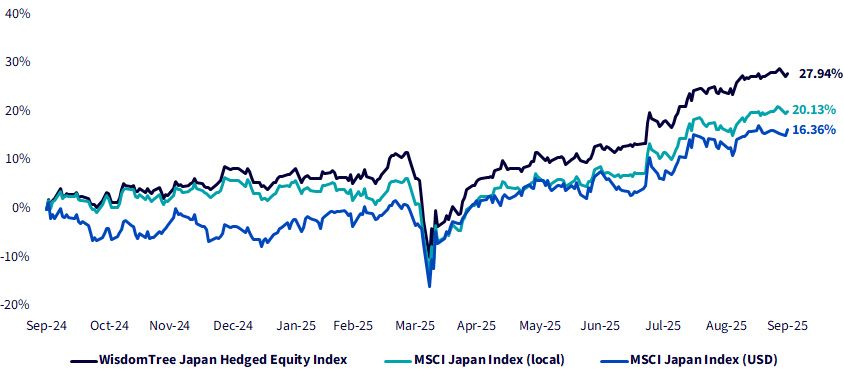
Sources: WisdomTree, MSCI. Data, 9/30/24–9/30/25. As of 9/30/2025, the WisdomTree Japan Hedged Equity Fund’s (DXJ) 30-day SEC Yield = 1.10%. Past performance is not indicative of future results. You cannot invest directly in an index.
At the small-cap level, the WisdomTree Japan SmallCap Dividend Index—which provides unhedged exposure to dividend-paying small-cap Japanese equities—also outperformed its benchmark, the MSCI Japan Small Cap Index, over the same period. The Index is tracked by the WisdomTree Japan SmallCap Dividend Fund (DFJ).
Figure 4: WisdomTree Japan SmallCap Dividend Index Total Returns
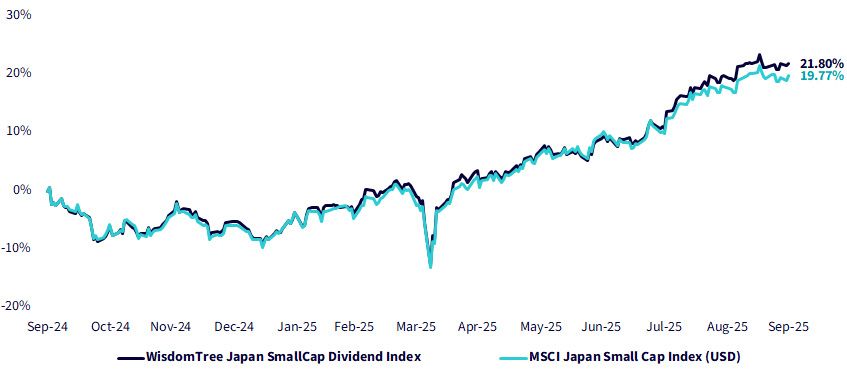
Sources: WisdomTree, MSCI. Data, 9/30/24–9/30/25. Past performance is not indicative of future results. You cannot invest directly in an index.
Rebalance Overview
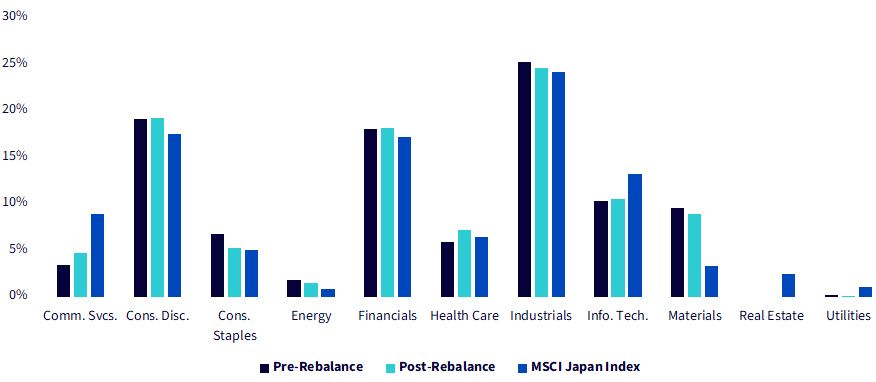
Following its rebalance, DXJ's Index slightly increased allocations to high-growth sectors like communications services, consumer discretionary, health care and information technology.
Overall, sector changes were fairly modest.
Figure 5: Sector Changes, WisdomTree Japan Hedged Equity Index
Sources: WisdomTree, MSCI, as of 9/30/25. You cannot invest directly in an index.
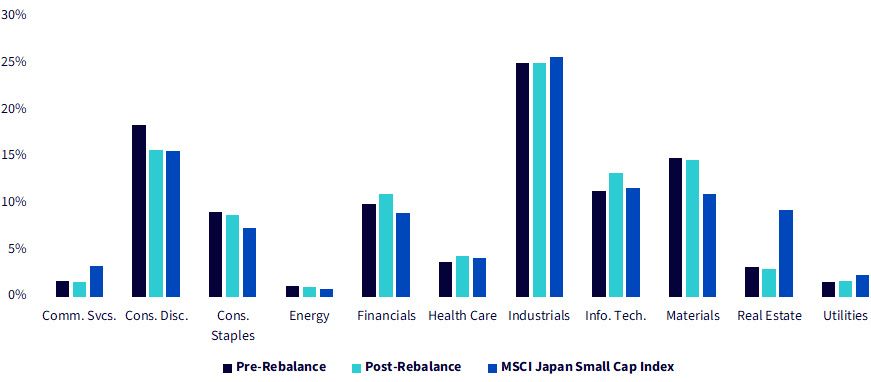
DFJ's Index increased allocations to the financials and information technology sectors while decreasing allocations to the consumer discretionary sector. Other changes were relatively muted.
Figure 6: Sector Changes, WisdomTree Japan SmallCap Dividend Index
Sources: WisdomTree, MSCI, as of 9/30/25. You cannot invest directly in an index.
Strengthened Fundamentals
Japan remains what our team calls the "anti-bubble," characterized by attractive valuations that are roughly 10 price-to-earnings (P/E) points below the S&P 500. Years of lower foreign fund flows have kept sentiment subdued, but Prime Minister Sanae Takaichi's pro-growth agenda, centered on fiscal spending and improved shareholder distributions, could spark renewed investor interest and a potential re-rating in Japanese equities.
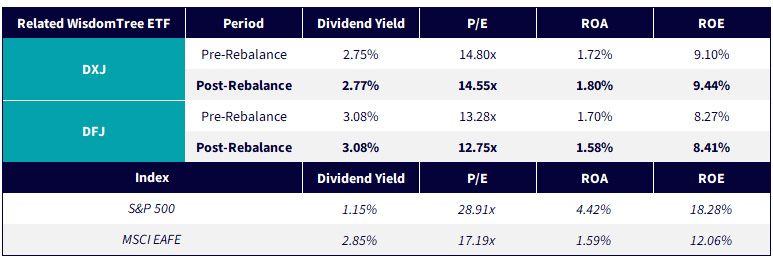
As a result of these rebalances, each Index saw improvements to fundamentals including dividend yield, P/E, return on assets (ROA) and return on equity (ROE).
Figure 7: Fundamentals
Source: WisdomTree, as of 9/30/25. You cannot invest directly in an index. As of 9/30/2025, the WisdomTree Japan Hedged Equity Fund’s (DXJ) 30-day SEC Yield = 1.10% and the WisdomTree Japan SmallCap Dividend Fund’s (DFJ) 30-day SEC Yield = 1.27%. The performance data quoted represents past performance and is not indicative of future results. Investment return and principal value of an investment will fluctuate so that an investor's shares, when redeemed, may be worth more or less than their original cost. Current performance may be lower or higher than the performance data quoted. For the most recent month-end and standardized performances, click the respective ticker: DXJ, DFJ.
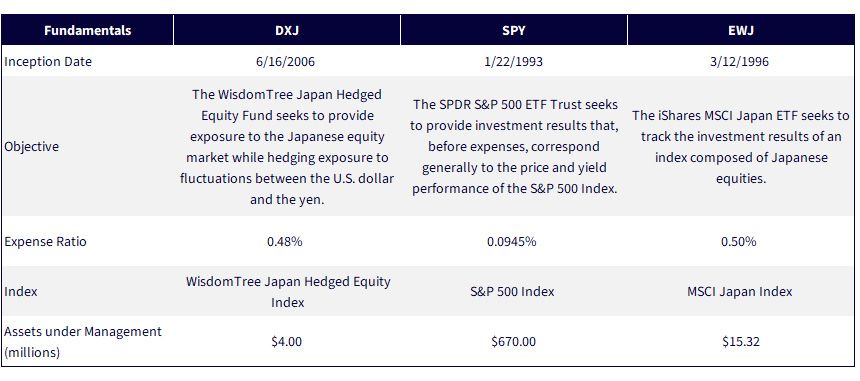
Figure 8: Additional Information
Source: WisdomTree, FactSet as of 9/30/25.
Important Risks Related to this Article
There are risks associated with investing, including the possible loss of principal. Foreign investing involves special risks, such as risk of loss from currency fluctuation or political or economic uncertainty.
DXJ: The Fund focuses its investments in Japan, thereby increasing the impact of events and developments in Japan that can adversely affect performance. Investments in currency involve additional special risks, such as credit risk, interest rate fluctuations and from derivative investments, which can be volatile and may be less liquid than other securities and more sensitive to the effect of varied economic conditions. As this Fund can have a high concentration in some issuers, the Fund can be adversely impacted by changes affecting those issuers. Due to the investment strategy of this Fund it may make higher capital gain distributions than other ETFs.
DFJ: Funds focusing their investments on smaller companies or certain sectors increase their vulnerability to any single economic or regulatory development. The Fund focuses its investments in Japan, thereby increasing the impact of events and developments in Japan that can adversely affect performance. This may result in greater share price volatility.
Please read the Fund’s prospectus for specific details regarding the Fund’s risk profile.
SPY: The fund is subject to risk, including possible loss of principal. The fund seeks to track the performance of the S&P 500 Index and does not attempt to outperform it. Equity securities may fluctuate in value in response to the activities of individual companies and general market and economic conditions. The fund is subject to general market risk, equity investing risk, and passive investment risk. ETFs may trade at prices above or below their net asset value (NAV) and are subject to brokerage commissions and trading costs.
Before investing, consider the fund’s investment objectives, risks, charges, and expenses. For more information, obtain a prospectus or summary prospectus at www.ssga.com or call 1-866-787-2257. Read it carefully.
EWJ: Carefully consider the Fund’s investment objectives, risk factors, and charges and expenses before investing. This and other information can be found in the Fund’s prospectus, and if available, summary prospectus, which may be obtained by calling 1-800-iShares (1-800-474-2737) or visiting iShares.com. Read the prospectus carefully before investing.
Investing involves risk, including possible loss of principal. International investing involves risks, including risks related to foreign currency, limited liquidity, less government regulation, and the possibility of substantial volatility due to adverse political, economic, or other developments. These risks are often heightened for investments in emerging or developing markets or in concentrations of single countries. Diversification may not protect against market risk or loss of principal. Shares of ETFs are bought and sold at market price (not NAV) and are not individually redeemed from the fund. Any applicable brokerage commissions will reduce returns. Past performance does not guarantee future results.
Categories
About the contributor

Research Analyst
Hyun Kang joined WisdomTree in July 2022 as a Research Analyst. As a part of the Index team, he assists with the creation and maintenance of the firm’s indexes and supports the group’s research initiatives across various strategies. Hyun graduated from Carnegie Mellon University, with a B.S. in Business Administration and an additional major in Statistics and Machine Learning.