
GDMN
Efficient Gold Plus Gold Miners Strategy Fund

Published February 27, 2025


Global Chief Investment Officer
Gold hit yet another new all-time high at US$2,849/ounce as U.S. economic data weakened, paving the way for a weaker U.S. dollar.1 At the same time, tariff threats by President Donald Trump continue to drive safe-haven demand. Central banks' strategic shift toward buying gold bullion as part of their reserves management has become an increasingly influential driver for gold since 2022. A combination of these factors has allowed gold to defy rate headwinds in 2025.
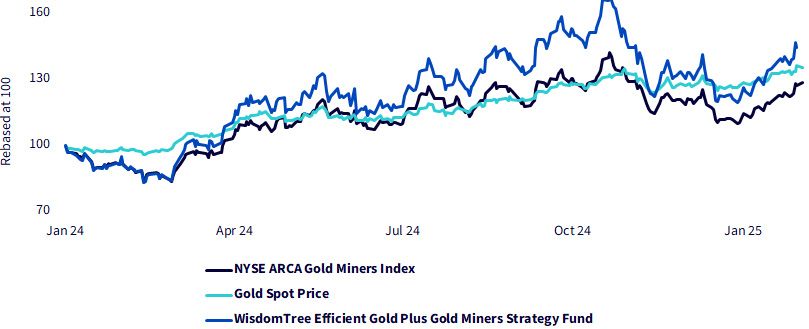
Sources: Bloomberg, WisdomTree, as of 1/31/25.
Gold miners (e.g., NYSE ARCA Gold Miners Index or the ETF GDX) struggled to keep pace with spot gold prices over the last 20 years, but in more recent times, they started performing better. This is evident by comparing the performance of:
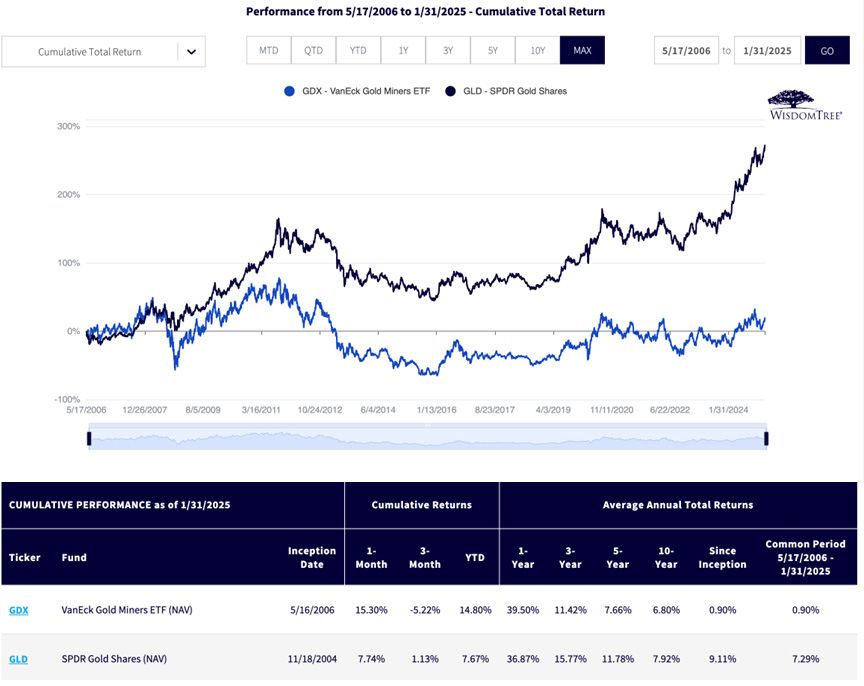
Source: WisdomTree, specifically data is from the Fund Comparison Tool in the PATH suite of tools, accessed 1/31/25. NAV denotes total return performance at net asset value. MP denotes market price performance Past performance is not indicative of future results. Investment return and principal value of an investment will fluctuate so that an investor's shares, when redeemed, may be worth more or less than their original cost. Current performance may be lower or higher than the performance data quoted. For the most recent month-end and standardized performances, click the relevant ticker: GDX, GLD.
WisdomTree saw that investors allocating to gold often chose both the commodity and the miners with separate allocations and thought a packaged solution that provides a capital-efficient solution to both would provide value to the marketplace.
The WisdomTree Efficient Gold Plus Gold Miners Strategy Fund (GDMN) adds gold futures on top of a position in gold miners. This provides leverage to the theme but means less capital in a portfolio can be allocated to the strategy to achieve similar economic total exposures.
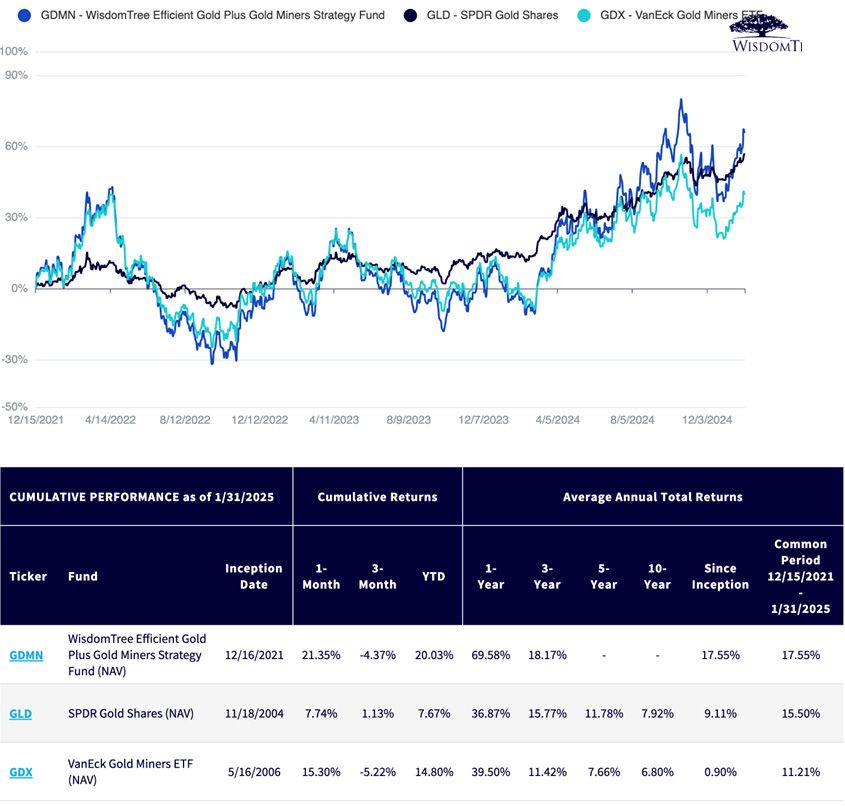
Source: WisdomTree, specifically data is from the Fund Comparison Tool in the PATH suite of tools, accessed 1/31/25. NAV denotes total return performance at net asset value. MP denotes market price performance. Past performance is not indicative of future results. Investment return and principal value of an investment will fluctuate so that an investor's shares, when redeemed, may be worth more or less than their original cost. Current performance may be lower or higher than the performance data quoted. For the most recent month-end and standardized performances, click the relevant ticker: GDMN, GDX, GLD.
Concerns over capital discipline and cost inflation weighed on miners over time, though cost pressures have eased. The all-in sustaining costs (AISC)—the breakeven cost to mine gold—rose by 13% in 2022 and 5.3% in 2023 but are expected to have declined in 2024.
More importantly, rising gold prices have increased miners' margins in recent years. In 2024, miners demonstrated cost discipline while maintaining margin growth. Recent cost control could drive an upward re-rating of miners.
Capital expenditures (CapEx) had been increasing steadily until the second half of 2024 but have since remained restrained. This could be partly due to the scarcity of Tier 1 gold assets available for development. As a result, mergers and acquisitions (M&A) are likely to play an increasingly critical role in sustaining or expanding production levels.
Operating margins improved from -11% in 2014 to +9% in 2024, comparable to levels in the general equity market. Yet sentiment toward the mining sector continues to remain weak.
Gold miner dividend yields at 1.67% currently surpass the S&P 500 Index at 1.3%.2 While U.S. equities are touted as expensive, the gold miners' EV/EBITDA valuation has fallen from 7.67x to 6.6x over the past decade.3
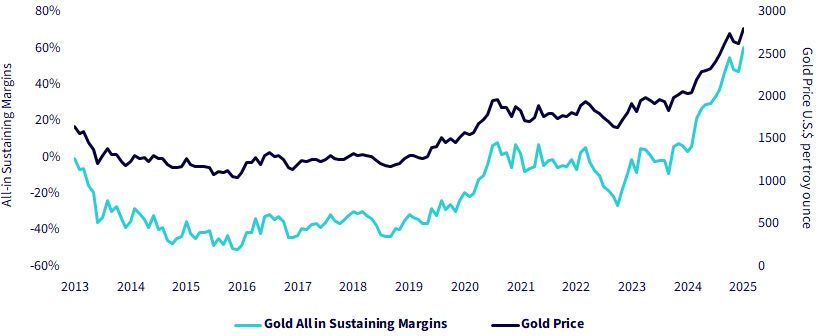
Sources: Bloomberg, WisdomTree, as of 1/31/25.
Gold mining stocks offer key benefits to an investor's portfolio—effective diversification alongside operational leverage to rising gold prices. They serve as a hybrid asset offering exposure to gold but with equity-like risk characteristics.
Unlike direct gold investments, which serve primarily as a store of value, gold miners generate revenue, incur operational costs and can provide dividends, making them more akin to traditional equities.
Given the impressive diversification benefits from an allocation to the precious metals sector, investors bullish on gold often allocate to both the physical precious metal and equities representing gold miners as separate allocations, which requires twice the investment capital. GDMN adopts a unique approach using leverage and a "return stacking" framework that layers gold futures on top of the miner's exposure, thereby offering better capital efficiency. As a result, investors can free up capital for other allocations while maintaining a robust position in the precious metals sector.
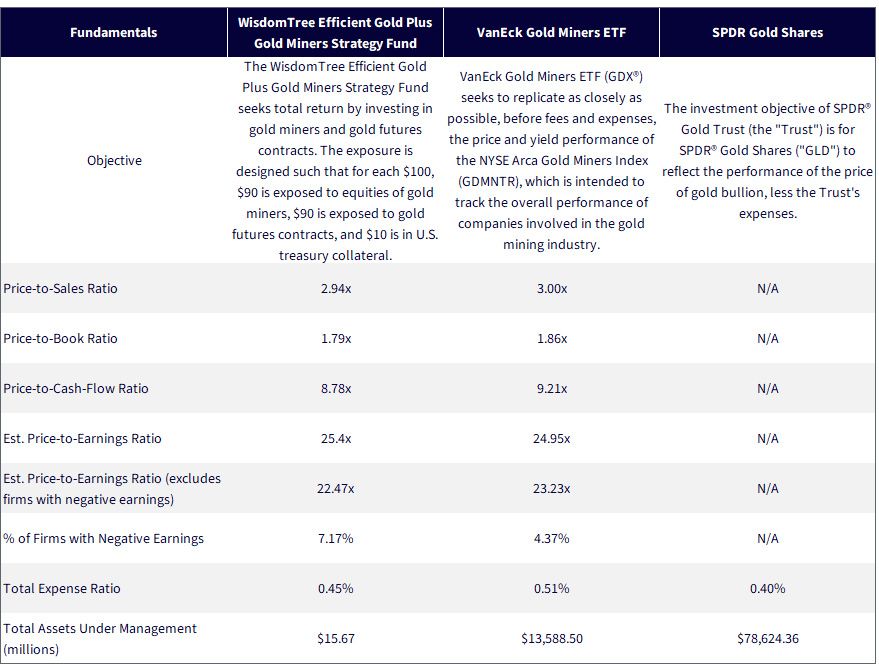
Source: WisdomTree, specifically data is from the Fund Comparison Tool in the PATH suite of tools, as of 12/31/24. Total expense ratio and total assets under management are current as of 1/31/25, with these measures taken from the specific Fund websites.
If you are interested in diving more into the comparison of these Funds, please check out our Fund Comparison Tool.
1 Front-month gold futures price as of 1/30/25, Bloomberg.
2 Bloomberg, gold miner's dividend is represented by the NYSE ARCA Gold Miners Index.
3 Bloomberg, gold miners' EV/EBITDA is represented by the NYSE ARCA Gold Miners Index as of 1/31/25.
All funds are managed differently and do not react the same to economic or market events. The investment objectives, strategies, policies or restrictions of other funds may differ and more information can be found in their respective prospectuses. Therefore, we generally do not believe it is possible to make direct fund to fund comparisons in an effort to highlight the benefits of a fund versus another similarly managed fund.
The WisdomTree Efficient Gold Plus Gold Miners Strategy Fund is an actively managed ETF, while the VanEck Gold Miners ETF and SPDR Gold Shares are passively managed.
GDMN: There are risks associated with investing, including the possible loss of principal. The Fund is actively managed and invests in U.S.-listed gold futures and global equity securities issued by companies that derive at least 50% of their revenue from the gold mining business (“gold miners”). The Fund’s use of U.S.-listed gold futures contracts will give rise to leverage, magnifying gains and losses and causing the Fund to be more volatile than if it had not been leveraged. Moreover, the price movements in gold and gold futures contracts may fluctuate quickly and dramatically and have a historically low correlation with the returns of the stock and bond markets. By investing in the equity securities of gold miners, the Fund may be susceptible to financial, economic, political or market events that impact the gold mining sub-industry, including commodity prices and the success of exploration projects. The Fund may invest a significant portion of its assets in the securities of companies of a single country or region, including emerging markets, and thus, the Fund is more likely to be impacted by events and political, economic or regulatory conditions affecting that country or region, or emerging markets generally. The Fund’s investment strategy will also require it to redeem shares for cash or to otherwise include cash as part of its redemption proceeds, which may cause the Fund to recognize capital gains. Please read the Fund’s prospectus for specific details regarding the Fund’s risk profile.
GDX: An investment in the Fund may be subject to risks which include, but are not limited to, risks related to investments in gold and silver mining companies, special risk considerations of investing in Australian and Canadian issuers, foreign securities, emerging market issuers, foreign currency, depositary receipts, small- and medium-capitalization companies, equity securities, market, operational, index tracking, authorized participant concentration, no guarantee of active trading market, trading issues, passive management, fund shares trading, premium/discount risk and liquidity of fund shares, non-diversified and index-related concentration risks, all of which may adversely affect the Fund. Emerging market issuers and foreign securities may be subject to securities markets, political and economic, investment and repatriation restrictions, different rules and regulations, less publicly available financial information, foreign currency and exchange rates, operational and settlement, and corporate and securities laws risks. Small- and medium-capitalization companies may be subject to elevated risks.
Investing involves substantial risk and high volatility, including the possible loss of principal. An investor should consider the investment objective, risks, charges and expenses of the Fund carefully before investing. To obtain a prospectus and summary prospectus, which contain this and other information, call 800.826.2333 or visit vaneck.com. Please read the prospectus and summary prospectus carefully before investing.
GLD: Investing involves risk, and you could lose money on an investment in SPDR® Gold Trust (“GLD®” or “GLD”). ETFs trade like stocks, are subject to investment risk, fluctuate in market value and may trade at prices above or below the ETFs’ net asset value. Brokerage commissions and ETF expenses will reduce returns. Commodities and commodity-index linked securities may be affected by changes in overall market movements, changes in interest rates and other factors such as weather, disease, embargoes, or political and regulatory developments, as well as the trading activity of speculators and arbitrageurs in the underlying commodities. Frequent trading of ETFs could significantly increase commissions and other costs such that they may offset any savings from low fees or costs. Diversification does not ensure a profit or guarantee against loss. There can be no assurance that a liquid market will be maintained for ETF shares. Investing in commodities entails significant risk and is not appropriate for all investors.
Important Information Relating to GLD: GLD has filed a registration statement (including a prospectus) with the Securities and Exchange Commission (“SEC”) for the offering to which this communication relates. Before you invest, you should read the prospectus in that registration statement and other documents GLD has filed with the SEC for more complete information about GLD and this offering. Please see the GLD prospectus for a detailed discussion of the risks of investing in GLD shares. When distributed electronically, the GLD prospectus is available by clicking here. You may get these documents for free by visiting EDGAR on the SEC website at sec.gov or by visiting spdrgoldshares.com. Alternatively, GLD or any authorized participant will arrange to send you the prospectus if you request it by calling 866.320.4053.
Efficient Gold Plus Gold Miners Strategy Fund

Director, Macroeconomic Research, WisdomTree Europe
@AneekaGuptaWTAneeka Gupta is Director of Research at WisdomTree. Prior to the acquisition of ETF Securities in April 2018, Aneeka worked as an Equity & Commodities Strategist at the company. Aneeka has 17 years of experience working as a Research Analyst across a wide range of asset classes. In her current role she is responsible for conducting analysis for all in-house equity, commodity and macro publications and assisting the sales team with client queries around products and markets. Prior to WisdomTree, Aneeka began her career as an equity analyst at Bear Stearns International Ltd in London. She also worked as an Equity Sales Trader at Sunrise Brokers across US and Pan European Exchanges. Before that she worked as an Equity Derivatives Sales Manager at Mashreq Bank in Dubai. Aneeka holds a Masters in Mathematics from Oxford University and a BSc in Mathematics from the University of Delhi, India. She is also a CFA Charterholder.

Global Chief Investment Officer
Jeremy Schwartz has served as our Global Chief Investment Officer since November 2021 and leads WisdomTree’s investment strategy team in the construction of WisdomTree’s equity Indexes, quantitative active strategies and multi-asset Model Portfolios. Jeremy joined WisdomTree in May 2005 as a Senior Analyst, adding Deputy Director of Research to his responsibilities in February 2007. He served as Director of Research from October 2008 to October 2018 and as Global Head of Research from November 2018 to November 2021. Before joining WisdomTree, he was a head research assistant for Professor Jeremy Siegel and, in 2022, became his co-author on the sixth edition of the book Stocks for the Long Run. Jeremy is also co-author of the Financial Analysts Journal paper “What Happened to the Original Stocks in the S&P 500?” He received his B.S. in economics from The Wharton School of the University of Pennsylvania and hosts the Wharton Business Radio program Behind the Markets on SiriusXM 132. Jeremy is a member of the CFA Society of Philadelphia.

