


The European Defense Awakening: From Rhetoric to Capital Flow
Published September 10, 2025

Christopher Gannatti, CFA
Global Head of Research

Samuel Rines
Macro Strategist, Model Portfolios
Key Takeaways
- With European defense spending surging 17% in 2024 and a NATO goal of 5% of GDP by 2035, capital is now targeting digitally native military systems rather than traditional hardware.
- Under-the-radar players like Chemring, INVISIO and MilDef are emerging as strategic winners, offering investors asymmetric upside in the high-tech backbone of Europe’s rearmament.
- The WisdomTree Europe Defense Fund (WDEF) provides targeted exposure to this defense-tech super-cycle, bypassing legacy primes in favor of agile, innovation-led firms critical to NATO’s modernization agenda.
The June 2025 NATO summit in The Hague didn't just mark a gathering of diplomats; it marked a turning point in Europe's defense identity. For decades, European capitals enjoyed a peace premium: underspending on defense while relying on the strategic umbrella of the United States. But that model has cracked. With Russia's invasion of Ukraine in 2022, the Trump administration's renewed warnings on NATO burden-sharing and the broader fragility of the global order, European leaders are now confronting a 30-year backlog in defense investment. The summit's centerpiece, a serious push toward 5% of GDP in defense spending by 2035, isn't just a budgetary adjustment; it's a tectonic policy shift.1
Defense spending in Europe surged 17% in 2024,2 but this is only the early innings. While traditional hardware grabs headlines, the real capital flows are forming around digitally native systems: electronic warfare, soldier modernization, tactical IT, autonomous platforms and secure battlefield networks. These aren't just military capabilities; they're infrastructure upgrades for a new geopolitical era. Critically, much of the value creation is occurring outside of the mega-primes. Small- and mid-cap3 defense tech firms in Europe, many still under the radar of global allocators, are seeing a tailwind they haven't experienced in a generation. For U.S. investors, this is not a question of whether defense is investable; it's a question of whether your exposure reflects the shape of modern rearmament.
Building the Digital Backbone of Modern Armies
Chemring Group may not be a household name in U.S. defense portfolios, but it probably should be. Based in the UK, Chemring operates in some of the most strategically sensitive and undersupplied corners of modern warfare. On the munitions side, the company holds a near-duopoly in advanced plastic explosives in Europe, sharing the stage only with France's state-owned Eurenco.4 In an era where nations are laser-focused on securing domestic supply chains for critical ordnance, Chemring's position is more than just competitive; it's structurally embedded.
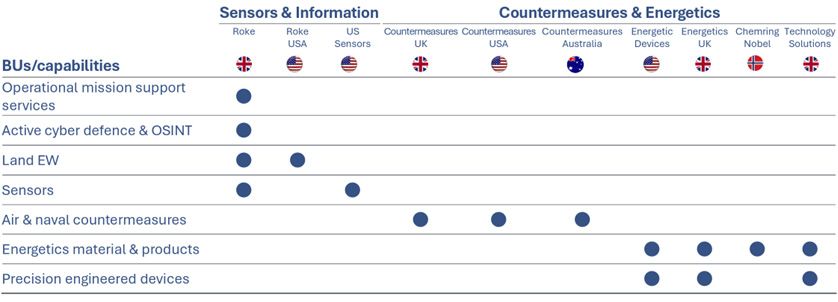
But what sets Chemring apart in this new defense investment cycle is its dual-track positioning. Alongside its heritage in energetic materials and countermeasures, Chemring has built a growing portfolio of capabilities in electronic warfare, signals intelligence and cyber defense, the high-tech plumbing of the 21st-century battlefield. The Ukraine war has crystallized the market's understanding that kinetics alone are no longer sufficient; electronic dominance is the new margin of safety. Reflecting this, Chemring has booked recent wins across Sweden, Lithuania, Latvia, the UAE and Japan, signaling not just regional relevance, but growing global demand for its electronic warfare systems.5
In short, Chemring is one of the few mid-cap European players riding both sides of the rearmament curve: traditional resupply and next-gen battlefield architecture. For U.S. investors looking beyond the primes, and beyond U.S. borders, it represents the kind of overlooked, thematically aligned name that could re-rate6 meaningfully as Europe's defense strategy modernizes from the inside out.
Figure 1: Chemring's Strategic Footprint: Bridging Kinetics and Digital Warfare across NATO and Allied Markets
Source: Chemring Group PLC. "2025 Interim results: Delivering the plan" [presentation], 6/3/25. https://www.chemring.co.uk/investors/reports-and-presentations.
Soldier Systems, Rewired: INVISIO and the Frontline Tech Renaissance
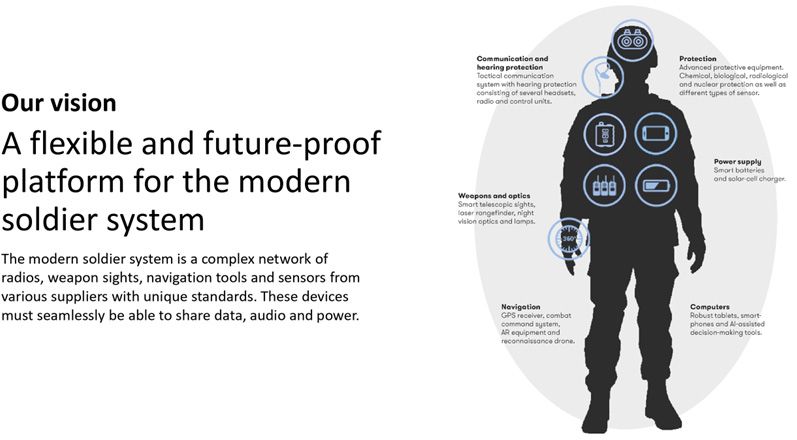
INVISIO isn't just selling headsets, it's selling survivability, coordination and modern battlefield coherence. Based in Denmark, INVISIO has become a go-to provider of advanced communication and hearing protection systems for NATO-aligned militaries.7 These aren't accessories; they're enablers of operational integrity in the noisiest, most electronic-dense combat environments seen since World War II (WWII). Troops using INVISIO kits can communicate effectively amid artillery barrages, urban drone buzz and armored vehicle convoys, all while preserving hearing and cognitive clarity. That may sound niche, but it's exactly the kind of modernization imperative that European defense ministries are prioritizing post-Ukraine.
The company's core technology stack includes AI-driven noise filtering, digital signal processing and modular communications hubs that integrate with tactical radios, helmet-mounted sensors and soldier-worn devices. As the war in Ukraine revealed deep coordination frictions and sensory overload on the battlefield, demand for INVISIO's capabilities has surged, not only in Europe but increasingly from NATO partners and Indo-Pacific allies.8 For U.S. investors, INVISIO offers exposure to a precision niche within the broader defense-tech upgrade cycle: soldier modernization. It's a structural theme with funding visibility, operational urgency and global export potential, all anchored by a company that's already a category leader in its segment.
Figure 2: The Modern Soldier System: A Fully Integrated, Data-Enabled Combat Platform
Source: INVISIO, "Q1 2025 investor presentation: Positioned for an eventful 2025" [presentation], 5/6/25. https://www.invisio.com/investors/reports-and-presentations.
MilDef: Wiring the Warfighter for the Digital Age
If the modern battlefield is increasingly defined by compute, connectivity and command infrastructure, then MilDef is one of Europe's mission-critical vendors. Based in Sweden, MilDef Group delivers ruggedized IT and networking gear purpose-built for frontline deployment, hardened laptops, servers, switches and communication systems designed to withstand kinetic shock, cyber threat environments and extreme conditions. In other words, MilDef isn't just a defense contractor; it's a digital infrastructure play embedded in the rearmament programs of multiple NATO allies.
MilDef has signed hardware deals with the Swedish Armed Forces for secure tactical comms gear.9 In 2024, MilDef expanded its footprint by acquiring a German military IT provider, positioning it to benefit directly from Germany's €100+ billion defense reset.10
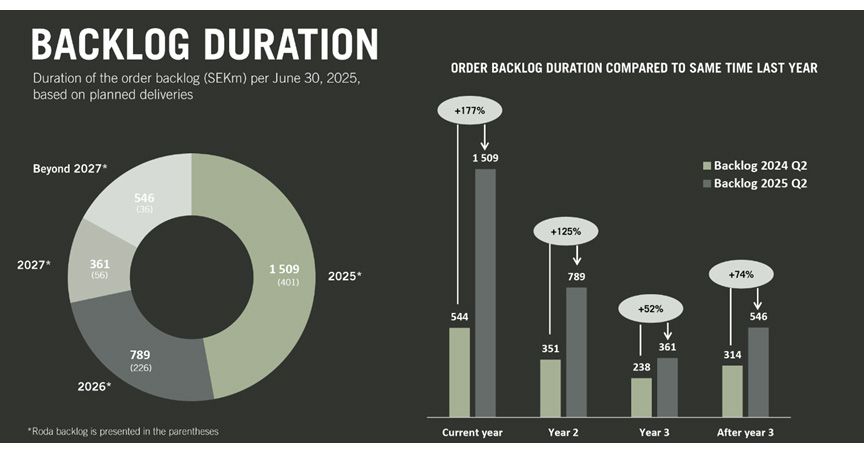
While global defense investors often focus on the primes, MilDef represents the kind of specialized mid-cap that rides upstream capital flow, not from headlines, but from systems integrators, joint programs and NATO procurement pipelines. It's also a key beneficiary of a second-order trend: Europe's pivot toward indigenous, secure supply chains for sensitive technology. With a growing backlog and increasing integration into multilateral defense programs, MilDef is well-positioned as the IT spine of Europe's military transformation.
Figure 3: MilDef's Deepening Backlog Signals Multi-Year Demand for Digital Defense Infrastructure
Source: MilDef Group AB, "Interim report March—June 2025" [report], 7/18/25. https://www.mildef.com/investors/reports-presentations/
Investing in Europe's Defense Renaissance: A High-Conviction, Under-Allocated Opportunity
Conclusion: Targeting the Digital Backbone of Europe's Rearmament
Europe's defense renaissance is no longer theoretical; it's on the books, in the budgets and flowing through to order backlogs. But what's often missed is that this is not simply about missiles or tanks; it's a digitally enabled rearmament. Tactical cloud networks, AI-enhanced soldier systems and electronic warfare are now commanding the spending growth. The names powering this shift aren't household staples like Airbus; they're Chemring, MilDef and INVISIO, firms that specialize in the compute, communications and ruggedization needed for modern deterrence. This isn't just reversion-to-mean defense spending; it's a super-cycle in strategic autonomy.
That's precisely why WisdomTree launched the WisdomTree Europe Defense Fund (WDEF). It is an ETF tracking the returns of the WisdomTree Europe Defense Index, a strategy purpose-built to capture Europe's defense modernization, concentrated in companies with both deep exposure and asymmetric growth potential. By screening for revenue-specific exposure to defense, WDEF sidesteps the legacy-industrial baggage and anchors investors directly to the innovation curve. If the macroeconomic story is that European security is now a structural investment priority, then WDEF is the vehicle that brings that thesis into a liquid, investable and scalable format.
Figure 4: Exposure in WDEF to the Companies Discussed in This Piece
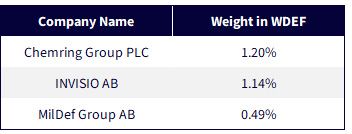
Source: WisdomTree, with data as of the market's open on 7/17/25, the first day of trading for WDEF. Subject to change.
1 Source: NATO, "The Hague Summit Declaration: Allies commit to a transformational leap in defence spending" in "2025 The Hague NATO Summit" (pp. 1–2). NATO Headquarters, 6/25/25.
2 Source: Stockholm International Peace Research Institute, "World military spending hits $2.72 trillion in record 2024 surge," Reuters, 4/27/25.
3 Small and mid-cap refers to market capitalization size segments. WisdomTree tends to see small cap as below $2 billion and mid-cap as between $2 billion and $10 billion.
4 Source: Edison Group, "Chemring Group: Record order book driving confidence," 5/25.
5 Source: Chemring Group PLC, "FY24 full-year results presentation transcript with Q&A" [transcript], 12/17/24.
6 Re-rate refers to a process where investors recognize a company aligning itself with an important narrative that causes those investors to reassess the company's valuation, typically in an upward fashion.
7 Source: Canadian Defense Review, "Tactical audio systems – INVISIO," 1/11/24.
8 Source: "INVISIO strengthens its ability to integrate the modern soldier system with the acquisition of UltraLYNX," Milipol News, 3/3/25.
9 Source: Juster Domingo, "INVISIO to supply European country with $45 M comms systems," The Defense Post, 3/15/24.
10 Source: MilDef Group AB, "MilDef successfully completes the acquisition of roda computer GmbH and resolves on an issue in kind" [press release], 3/6/25.
Important Risks Related to this Article
For current holdings of WDEF, please click here. Holdings are subject to risk and change.
There are risks associated with investing, including the potential loss of principal. Foreign investing involves specific risks, such as risk of loss from currency fluctuation or political or economic uncertainty. Funds focusing their investments on certain sectors increase their vulnerability to any single economic or regulatory development. This may result in greater share price volatility. This Fund focuses its investments in Europe, thereby increasing the impact of events and developments in Europe that can adversely affect performance. Europe has and may continue to experience security concerns, war, threats of war, aggression and/or conflict, terrorism, economic uncertainty, sanctions or the threat of sanctions, natural and environmental disasters, the spread of infectious illness, widespread disease or other public health issues and/or systemic market dislocations that lead to increased short-term market volatility and have adverse long-term effects on European and world economies and disrupt the orderly functioning of securities markets generally, which may negatively impact the Fund’s investments. Many countries within Europe are closely connected, and their economies and markets are largely interdependent. As such, economic and political events in one European country, including monetary exchange rates between European countries and armed conflicts among two or more European countries, may have adverse effects across Europe. European countries that are members of the European Union (“EU”) and the European Economic and Monetary Union (“EMU”) are subject to certain economic and monetary policies and controls and the risks associated with such coordinated economic and fiscal policies. Because the Fund invests primarily in the securities of companies in Europe, the Fund’s performance is expected to be closely tied to social, political and economic conditions within Europe and to be more volatile than the performance of more geographically diversified funds. Investments in non-U.S. securities involve political, regulatory and economic risks that may not be present in investments in U.S. securities. The securities of small-capitalization companies generally trade in lower volumes and are subject to greater and more unpredictable price changes than larger-capitalization stocks or the stock market as a whole. The Fund invests in the securities included in, or representative of, its Index. The Index may not perform as intended. Please read the Fund’s prospectus for specific details regarding the Fund’s risk profile.
Categories
About the contributors

Christopher Gannatti, CFA
Global Head of Research
Christopher Gannatti began at WisdomTree as a Research Analyst in December 2010, working directly with Jeremy Schwartz, CFA®, Director of Research. In January of 2014, he was promoted to Associate Director of Research where he was responsible to lead different groups of analysts and strategists within the broader Research team at WisdomTree. In February of 2018, Christopher was promoted to Head of Research, Europe, where he was based out of WisdomTree’s London office and was responsible for the full WisdomTree research effort within the European market, as well as supporting the UCITs platform globally. In November 2021, Christopher was promoted to Global Head of Research, now responsible for numerous communications on investment strategy globally, particularly in the thematic equity space. Christopher came to WisdomTree from Lord Abbett, where he worked for four and a half years as a Regional Consultant. He received his MBA in Quantitative Finance, Accounting, and Economics from NYU’s Stern School of Business in 2010, and he received his bachelor’s degree from Colgate University in Economics in 2006. Christopher is a holder of the Chartered Financial Analyst Designation.

Samuel Rines
Macro Strategist, Model Portfolios
Samuel Rines is a Macro Strategist at WisdomTree, where he extends the firm's custom model portfolio management capabilities. Before joining WisdomTree in 2024, he was the Managing Director at CORBU, LLC, leading the PolyMacro advisory product. With over a decade of experience in economics and finance, Samuel has held significant roles such as Chief Economist at Avalon Investment & Advisory and Economist and Portfolio Manager at Chilton Capital Management LLC. He is also the author of "After Normal: Making Sense of the Global Economy," and holds a Master’s degree in Economics from the UNH Peter T. Paul College of Business and Economics, as well as having studied Economics at the University of Oxford.